
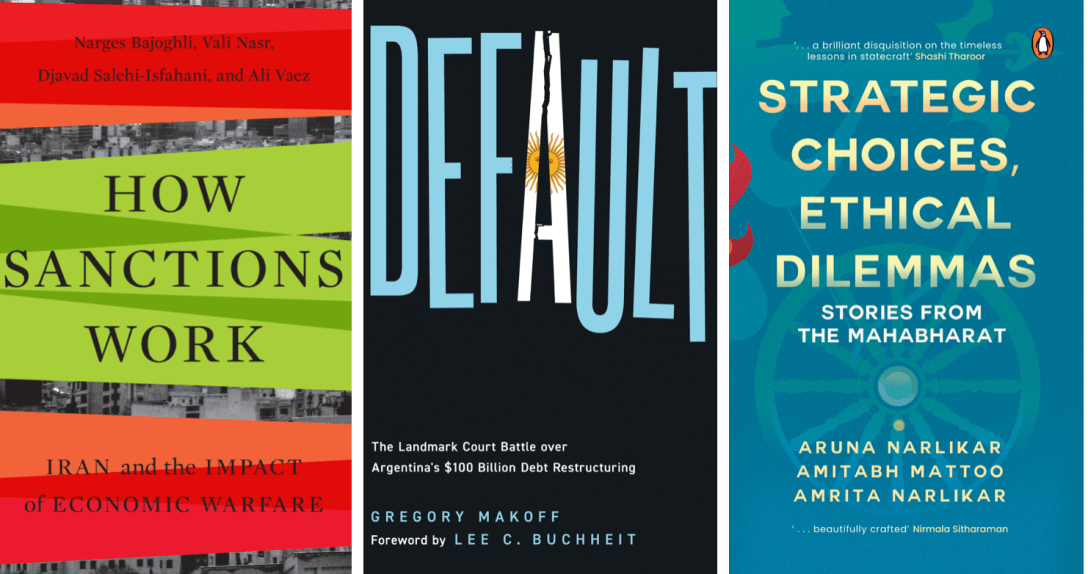
Important reads on Argentine economic/debt crisis, the impact of sanctions and Indian foreign policy.


Normally I only collect together important reads at year end (see 2023 here), but I decided to make an exception. These three books are important enough in their various areas of foreign economic policy that I didn’t want to wait to share them as they raise important questions about developing foreign issues, policy dilemmas and perspectives.
How Sanctions Work: Iran and the impact of Economic Warfare. By Narges Bajoghli, Vali Nasr, Djavad Salehi-Isfahani and Ali Vaez
This book, by a quartet of Iranian-origin social scientists, some based in Iran and some outside, is a rare deep dive into the impact of sanctions on Iran, especially those imposed over the last decade (but also the long tail of my lifetime) and the unanticipated consequences. The authors make the case that sanctions (especially the 2018 snapback following the US withdrawal from the JCPOA) increased the chance of conflict rather than reducing it. It’s a rare book that brings forward extensive interviews with a cross-section of Iranians – itself something most of us in the US (or elsewhere in G7) face challenges accessing and is worthwhile reading on that note. It’s also a useful historical cross-section of how Iran’s political economy has been affected by sanctions.
Their conclusions about the ways that comprehensive sanctions can perversely consolidate state and military power, undermining the private sector that the sanctions senders may think they are shielding, is borne out by other cases (see Russia today), and some of the sanctions literature – and indeed some pieces I’ve written. As many statecraft watchers are assessing the circumstances in which sanctions can bring change (and whether these are positive changes) or whether they can only be used for degrading capacity, this book is a useful contribution. I’ll be writing more about it in the coming days and weeks and it just might find its way on to a certain syllabus I’m crafting.
Default: The Landmark Court Battle over Argentina’s $100 billion Debt Restructuring by Gregory Makoff.
Makoff, a long-time sovereign debt expert, set out to capture the many waves and turns of Argentina’s decade long debt restructuring, the stories of the holdouts and much more. He packs a lot of detail about the many overlapping legal cases, the players on all sides and the macro conditions into this ‘courtroom drama’, which doubles as a guide about challenging debt restructuring, Although debt markets have undergone some innovations since and because of the Argentine saga, especially changes in collective action clauses that would prevent the degree of holdouts, the political economy of why both Argentina and some of the holdouts refused to settle is important reading and difficulty reaching resolution is still too common. Despite efforts around the common framework, each debt restructuring process is still far too unique and far too complex.
As some of you know, Argentina featured heavily in my MPhil thesis on politics of dollarisation, and in a way, Greg’s story picks up where mine story left off, with the debt that remained after the currency and financial crisis of the late 1990s/2001. Worth reading if you followed part of the saga as I did or even if you didn’t. I found the sections on attachment or attempted attachment of sovereign assets particularly useful both for the ongoing Venezuela debt issues, but also for context about the very different attempts to extract funds from Russia’s immobilized assets. The story also highlights the importance of individual decisions, the choices of Judge Griesa, various Argentine officials, investors and advisers, but ultimately highlights the challenges that are still involved in sovereign debt restructuring – as those trying to address today’s thorny challenges including the more know well.
Strategic Choices, Ethical Dilemmas: Stories from the Mahabharat by Aruna Narlikar, Amitabh Mattoo and Amita Narlikar.
This slim book uses tales from the Indian classic epics Mahabharat to take lessons for current life and domestic and foreign policy. Not only are the summarized stories themselves compelling and worth a read on their own, but the lessons for foreign policy, especially Indian is quite useful. For example there are a number of stories with lessons G7 policymakers might well have benefited from reading before pressuring India over Russia and in thinking about India’s role within the expanding BRICS and other groupings
I’m sure those who heard the tales as children might take something deeper from the book or could have scanned the stories, as they already had some of the cultural references I lacked. But the book helps to encourage people like me who did not grow up with foundational stories from India to fill gaps., Its a particularly useful intro to the narratives that may resonate over social and policy discussion in India and provides a perspective on how and where today’s officials may see tradeoffs. The themes cover not only foreign policy but animal welfare, domestic policy choices and other potential missteps.

 Ziemba Insights